INTERBALL Tail Science Mission
The mission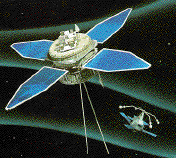
The out flowing plasma from the sun's atmosphere called the solar wind, continuously bombards the Earth's magnetosphere. The high velocity of the solar wind results in the formation of a bow shock upstream of the magnetosphere. The solar wind is heated and slowed as it crosses the bow shock forming the magnetosheath. It is within this region that directly contacts the magnetosphere that the transfer of solar wind mass and energy into the magnetosphere occurs. The interplanetary magnetic field (IMF) convected via the solar wind into the magnetosheath drapes around the outer boundary of the magnetosphere, known as the magnetopause. Where the orientation of the magnetic field within the magnetosheath is opposite to the magnetosphere the two field lines can merge together thereby allowing direct entry of solar wind plasma into the magnetosphere.
INTERBALL Tail was launched into an inclined elliptical orbit on the nn of mmm 1995 with an orbital period of XXX. This orbit allows INTERBALL Tail to observe the magnetopause for extended periods. The extensive suite of scientific instrumentation carried aboard Polar is used to study the detailed nature of the bow shock magnetosheath and magnetopause and the transport of mass and energy across these regions.
ResearchOne of the principal limitations of making observations from a single spacecraft is that these observations are from a single point. Since this observation point is in motion, orbiting the Earth, there is an inherent uncertainty nature of any observation. The observation could be of a spatial effect; the movement of the observation point from one region to another or of a temporal effect; the characteristics of the region have varied. Observations from more that one point can resolve this ambiguity. To this end INTERBALL Tail and Polar spacecraft data have been used in conjunction to differentiate spatial and temporal phenomena.