Mars Express
The missionMars Express is the first European Space Agency 'Flexible' mission, comprising the Mars Express orbiter and the Beagle 2 lander. Launched successfully on 2 June 2003 at 18:45 BST on Soyuz-Fregat. Now in Mars orbit!
Science objectives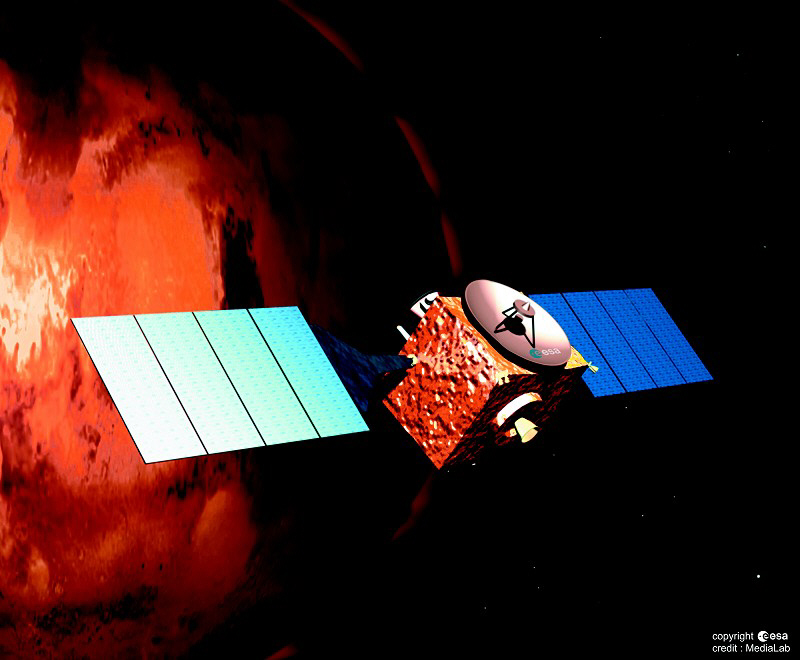 One of the major differences between Mars and the Earth is that Mars lost its magnetic field
early in the planet's history, leaving it unmagnetized except in a few small areas of the crust.
Now, and for the past 3 billion years, the atmosphere and ionosphere of Mars can be 'scavenged'
directly by the solar wind. This atmospheric loss process cannot happen at Earth. Scavenging starts
in the same way that the solar wind interacts with comets and it ends with the loss of atmosphere
along the planet's tail. The atmospheric pressure at the Mars surface is now only 1% of that at Earth.
One of the major differences between Mars and the Earth is that Mars lost its magnetic field
early in the planet's history, leaving it unmagnetized except in a few small areas of the crust.
Now, and for the past 3 billion years, the atmosphere and ionosphere of Mars can be 'scavenged'
directly by the solar wind. This atmospheric loss process cannot happen at Earth. Scavenging starts
in the same way that the solar wind interacts with comets and it ends with the loss of atmosphere
along the planet's tail. The atmospheric pressure at the Mars surface is now only 1% of that at Earth.
The vital ingredient for life is water. We know that water is being replenished into the Martian atmosphere from somewhere below the surface, only to be lost by solar wind scavenging. The Aspera instrument on the Mars Express orbiter will measure the loss of water and study scavenging in detail. The water loss can then be estimated over billions of years, giving clues about conditions for past life on the planet.
MSSL are co-investigator in the Aspera team, providing electron calibration (electron sensor built by SwRI), internal blackening and scientific collaboration. One aspect would have been to compare the measurements on the orbiter with our water abundance measurements from Beagle 2 on the surface.
Now, we are studying electrons in the Martian environment, including their behaviour near Martian magnetic anomalies and their effect on plasma escape.
Further InformationThe Mars Express homepage at ESA
The IRF Aspera homepage at IRF