|

|
|
 |
|
This site is no longer being updated, but is left online for information.
|
Welcome |
Moon |
Europa |
Ganymede |
Titan/Enceladus |
Mars |
Consortium |
|
|
 |
|

|
|
|
News
- June 2010 Update on Penetrators for the Moon, Ganymede, Europa & Mars
- Aug 2009 Moon Exploration 40 years on... Pod Broadcast
- Jun 2009 Astrobioloqy Signals with Penetrators on Europa
- May 2009 Declaration of Interest in penetrators for Ganymede & Europa submitted to ESA
- July 2008 International Peer Review Strongly Endorses MoonLITE
- May 2008 Impact Trial - A Success
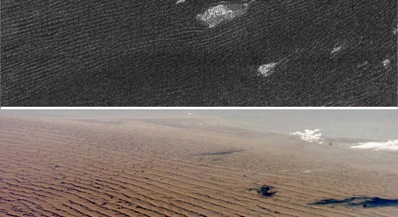 |
Top - Dunes on Titan Bottom - dunes in Namibia
JPL images |
|---|
Titan and Enceladus are extraordinary Moons of Saturn.
Titan, though similar in size to our Moon, has an atmosphere denser than Earth's; clouds; wind; weather; lakes; rivers; mountains and dunes. Though its surface chemistry is not oxygen and water based, it has a very complex organic chemistry, and is a potential candidate to harbour life.
Enceladus is equally unusual, but in a totally different way. It is smaller than the UK, though spherical in shape, with a powerful geyser near its south pole emitting chemicals into space, which include water molecules.
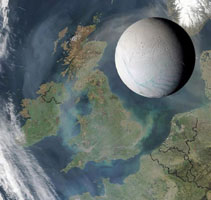 |
Enceladus - Size compared to UK
NASA Image |
|---|
The proposed ESA/NASA mission TanDEM to investigate both these astounding worlds, narrowly lost out to the Europa/Ganmede Jupiter mission. However, studies continue with particular interest being the deployment and operation of a balloon and an associated Lake Lander.
We believe that Penetrators dropped into the surface of Titan could be potentially useful in the search for biomarkers and investigatation of habitability; internal structure; chemical and physical properties. Deployment from a balloon into the dunes and alluvial plains could be a particularly suitable very low mass solution, offering relatively low gee-force impacts of all worlds in the solar system.
Deployment onto Enceladus would, however, be much more challenging requiring a relatively high mass due to the need for rocket deceleration in the absence of nearby bodies to achieve the necessary delta-V bleed-off. Location of a suitable impact site would also have to be addressed.
However, we wish the best for such a mission to the Saturniun system, and hope that the chance to investigate Enceladus from the surface is not passed over in the probable once-in-a-lifetime opportunity.
Titan-Enceladus Penetrator Presentations
- Penetrators for TSSM, Monrovia,LA,U.S.A (Jun08)
- Penetrators for Enceladus, Meudon,France (Mar08)
- Titan-Enceladus ESA Cosmic Visions (Feb07)
1st February 2011, Rob Gowen. rag@mssl.ucl.ac.uk
Mullard Space Science Laboratory - Holmbury St. Mary, Dorking, Surrey. RH5 6NT. -
 +44 (0)1483 204100
- Copyright © 1999-2005 UCL
+44 (0)1483 204100
- Copyright © 1999-2005 UCL
