Science with 4 Spacecraft
Why Four Spacecraft?
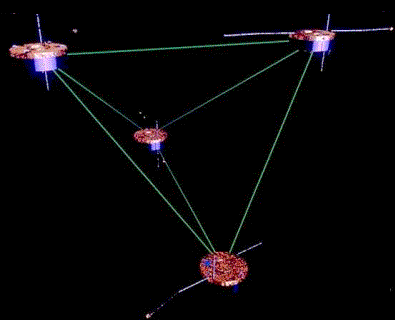
Each Cluster spacecraft carries 11 experiments, which measure the charged particles arriving at the spacecraft, the background electric and magnetic field surrounding the spacecraft and the waves (radio and other electromagnetic and plasma wave disturbances) which pass by the spacecraft. But most of the "senses" of the spacecraft are short range only. A single spacecraft can only observe what is happening at one point in space, whereas with four spacecraft scientists can infer things about an extended region of space (defined by the spacecraft separation). Cluster II presents scientists with unrivalled opportunities to study our magnetosphere in three dimensions.
The following pages show some of the advantages of having 4 spacecraft over single spacecraft observations:
Characterising plasma flows - plasma flow uniformity, gradient and vorticity
Characterising plasma waves - observing waves and their direction
Measuring structure - looking at the thickness of structures and their movement
Last updated on 08/08/00
by Sarah
Szita