
3-D Views of the Cycling Sun in Stellar Context
Beijing, China, 20-22 August 2012
Solar and stellar talks are to be presented side by side on state of the art observations and modeling of activity patterns, flares and CMEs, 3D views of the Sun and active stars from their interiors to their atmospheres and astrospheres, state of the art observations and modeling of magnetic field and activity patterns, flares and megaflares over the solar and stellar cycles will be discussed.
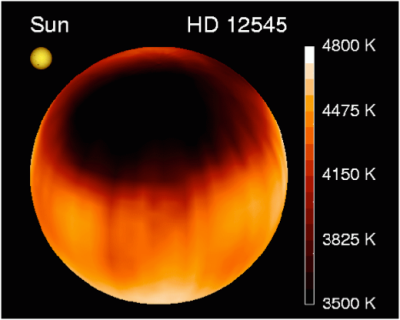
Image credit: Klaus Strassmeier (Leibniz Institute for Astrophysics Potsdam, Germany), Coude Feed Telescope, AURA, NOAO, NSF.
Program:
20 August (Mon) 10:30-12:30 – Chair: van Driel-Gesztelyi
10:30: Welcome and introduction – L. van Driel-Gesztelyi
1. Evolution of solar and stellar magnetic fields
10:35 Todd Hoeksema: The evolution of the solar magnetic field (Keynote)
11:05 Manuel Gudel: Evolution of stellar magnetic fields (Keynote)
11:35 Anqin Chen, Jingxiu Wang: Vector magnetic field characteristics of the super-active regions with major flare activity
11:50 Arnab Choudhuri, Bidya Karak: Theoretical modeling of grand minima of solar activity using the flux transport dynamo model
12:10 Peng-Fei Chen: 3D view of "EIT waves" in the solar corona
20 August (Mon) 14:00-15:30 - Chair: John Leibacher
2. Driving magnetic activity: differential rotation from seismology and patterns in surface activity - Observations and theory
14:00 Mark Miesch: Convection, shear and Magnetism in the Sun and its implications for cyclic solar and stellar activity (Keynote)
14:30 Klaus Strassmeier: Driving magnetic activity: differential rotation, flow structures, and surface patterns (Keynote)
15:00 Krisztian Vida: Activity in low-mass stars: spatial correlation and evolution of the observed features (solicited)
15:15 Shaolan Bi: Revised solar models with rotation and magnetic fields (solicited)
20 August (Mon) 16:00-18:00 - Chair: Mark Miesch
3. Magnetic activity from microflares to megaflares - Observations and theory
16:00 Lyndsay Fletcher: Solar state of the art observations and modelling (Keynote)
16:30 Adam Kowalski: Stellar state of the art observations and modelling (Keynote)
17:00 Hugh Hudson: The X-ray limb of the Sun (solicited)
17:15 Jun Lin, Zhixing Mei, Chengcai Shen: Solar Flare, CME, and the Reconnecting Current Sheet in Between
17:30 Janusz Sylwester, Barbara Sylwester, Kenneth J.H. Phillips: Solar Flare Sulphur Abundance
17:45 Barbara Sylwester, Janusz Sylwester, Anna Kepa, Tomasz Mrozek, Kenneth J.H. Phillips: Flare Differential Emission Measure from RESIK and RHESSI Spectra
21 August (Tue) 10:30-12:30 - Chair: Takashi Sakurai
4. 3-D views of the Sun and active stars - surfaces and interiors
10:30 Allan Sacha Brun: Simulating the solar dynamo in 3-D (Keynote)
11:00 Heidi Korhonen: 3-D reconstructions of active stars – observations (Keynote)
11:30 Debi Prasad Choudhary: Chromospheric Properties of Sun as a Star
11:45 Junwei Zhao: Stathis Ilonidis, Alexander Kosovichev: Helioseismic Studies of Solar Far-Side Active Regions and Emerging Active Regions
12:00 Poster presentations (11x2.5-min)
22 August (Wed) 10:30-12:30 Chair: Peng-Fei Chen
5. 3-D views of the Sun and active stars – atmospheres and astrospheres
10:30 Alexis Rouillard: 3-D perspectives of solar activity – modelling (Keynote)
11:00 Moira Jardine: 3-D perspectives of stellar activity – observations and modelling (Keynote)
11:30 Etienne Pariat, Guiallume Aulanier, Antonia Savcheva, Sophie Masson, Pascal Démoulin: Magnetic topology of solar activity events (solicited)
11:45 Lucie M. Green: Multi-wavelength observations of solar eruptions (solicited)
12:00 Dibyendu Nandy, Allan Sacha Brun, Ed Cliver, Sarah E. Gibson, Margit Haberreiter, Andres Munoz-Jaramillo, Steven H. Saar, Adriana Silva-Valio, Ilya Usoskin: Solar-Stellar Cycles and their Implication on the Astrospheres
12:15 Hui Li: Magnetic energy evolution and its relation to solar flares
22 August (Wed) 14:00-15:30 Chair: Hugh Hudson
6. Solar and stellar cycles
14:00 Robert Cameron: The solar cycle: looking forward after a long and deep minimum (Keynote)
14:30 Emre Isik: Theoretical models of stellar activity cycles (Keynote)
15:00 David Webb: Solar Cycle variations of Coronal Mass Ejections
15:15 Aline Vidotto, Rim Fares, Moira Jardine, Jean-Francois Donati, Merav Opher, Claire Moutou, Claude Catala, Tamas Gombosi: The stellar wind cycles and planetary radio emission of the Tau Boo system
22 August (Wed) 16:00-18:00 Chair: Karel Schrijver
7. Session - New results from SDO and Kepler
16:00 Jon M. Jenkins, Lucianne Walkowicz, Soeren Meibom, David Latham, Ronald Gilliland, Douglas Caldwell, William Borucki, Natalie Batalha, Gibor Basri: Stellar Variability Observed by Kepler (Keynote)
16:30 Marcelo Emilio, Jeff Kuhn, Rock Bush, Isabelle Scholl: P and R modes in solar limb shape HMI-SDO observations
16:45 Jie Chen: An analysis of a Transequatorial Loop (15-min)
17:00 Yingna Su, Aad van Ballegooien: Observations and magnetic field modeling of a solar polar crown prominence
17:15 Kiyoto Shibasaki: Relation between solar activities at low and high latitudes inferred from microwave observations
17:30 Yuzong Zhang: Revision of solar spicule classification
17:45 Concluding remarks – Karel Schrijver (10 min)
Posters:
Isroil Sattarov, Nina Karachik, Chori Sherdanov, Azlarkhon Tillaboev, Bobur Tokhtaev: Solar Cycle for Coronal Bright Points
Hugh Hudson: First Flare Results from EVE
Chuan Li, Yu Dai, Sarah Matthews: A test for IP shock prediction models by multipoint observations
L. van Driel-Gesztelyi, D. Baker, T. Török, E. Pariat, L.M. Green, D.R. Williams, G. Valori, P. Démoulin, S.A. Matthews, E. Pedram, B. Kliem, P.F. Chen: Observations and modeling of a massive filament eruption, CME, and coronal wave
L. van Driel-Gesztelyi, J. L. Culhane, D. Baker, P. Démoulin, C.H. Mandrini, M.L. DeRosa, A.P. Rouillard, A. Opitz, G. Stenborg, A. Vourlidas, D.H. Brooks: Plasma outflows from active regions: are they sources of the slow solar wind?
Ting Li: Interaction of solar global EUV wave with coronal structures
Zhi'e Liu: Solar-like oscillation in KIC 10516096,KIC 10644253 and KIC 11771760
Li Feng, Bernd Inhester, Yong Wei, Marilena Mierla, Weiqun Gan, Tielong Zhang, Mingyuan Wang: Morphological evolution of a 3D CME cloud reconstructed from three viewpoints and its comparison with other four reconstruction methods
Jie Jiang, Emre Isik, Robert Cameron, Dieter Schmitt, Manfred Schuessler: The Effect of Activity-related Meridional Flow Modulation on the Strength of the Solar Polar Magnetic Field
Valery Krivodubskij, Alexej Loginov, Oleg Cheremnykh, Nikolaj Salnikov: Hydrodynamic model of spatial and temporal variations of poloidal and toroidal components of 3D Sun flows
Nariman Ismailov, Peter Shustarev, Fekhrende Alimardanova, Gunel Bahaddinova: Planet formation processes in young solar-type stars
Supporting Divisions:
- Division II – Sun & Heliosphere
- Division V – Variable Stars
Organising Commission:
- Commission 10 – Solar Activity
Endorsed by:
- Commission 12 – Solar Radiation & Structure
- Commission 27 – Variable Stars
Day-camp for children at the IAU GA
In collaboration with the educational programme Universe Awareness (www.unawe.org) and Sterrenlab (www.sterrenlab.com), the International Astronomical Union is organising a day-camp for children of astronomers attending the General Assembly in Beijing. This programme will allow parents to attend the conference in a family friendly environment combining professional duties and family needs; the day-camp will offer a rich programme of science and cultural activities.
You can find more information about the UNAWE Day Camp at: http://iau.org/scientific_meetings/iau_ga_2012/special_events/unawe_workshop/
The following possibilities are available for financial support:
SPD Studentship and Metcalf Travel Award programs
Thanks to the generous support of the SPD Studentship Committee (funded by NSF), and the SPD's Metcalf Travel Award program, we will be able to provide partial financial support for early career researchers.
SPD Studentship: available to students enrolled at a US University, who have not yet completed their PhDs. Metcalf Travel Award: avalaible to researchers who have completed their PhD no more than five years before the start date of the General Assembly (August 20, 2012) and are members of the Solar Physics Division of the AAS.
These awards will be assigned jointly with the organizers of the other solar-related events at the GA (IUAS 294 ; JD3 ; SpS10). If interested, please submit an abstract, and send a 1-page CV and a letter of recommendation to iau_sps6@arcetri.astro.it https://webmail.obspm.fr/src/compose.php iau_sps6 @ arcetri.astro.it before February 29, 2012, specifying also which solar events you are interested in attending.
IAU travel grants
The IAU is offering a limited number of grants to support participation at the XXVIII IAU General Assembly. Grants are usually available to young astronomers and researchers from less privileged countries. For more information, please consult the IAU website at http://www.iau.org/grants_prizes/iau_grants/ga_events.