Slide 20 of 31
Notes:
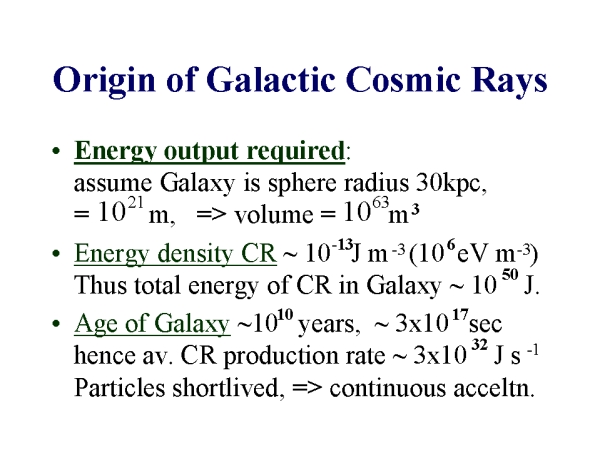
Before we take a look in any detail at which sources produce cosmic rays, we will calculate what the rate of production of cosmic rays in the galaxy actually is. So we need to know how many cosmic rays there are now, and since these are trapped in the galaxy, divide this by the lifetime of the galaxy to see how many were produced per second.
We know that the energy density of cosmic rays in the galaxy is about 1e6 eV per cubic metre = 1e-13 Joules per cubic metre.
To find the total cosmic ray energy we need to multiply by the volume of the Universe - so we assume that it’s a sphere with a radius of 30kpc - and that gives us a volume of 1e63 cubic metres. Thus the total energy in cosmic rays in the Galaxy is 1e50 Joules.
Galaxies formed about 10 billion years ago - so finally, we find an average cosmic ray production rate of 3e32 Joules per second (1e50/3e17).
Cosmic ray particles seem to be shortlived, thus they require a source of continuous acceleration.